Blog
Three Reasons to Go Native with Entity Resolution in Snowflake
September 12, 2026 | 6 min read



September 12, 2026 | 6 min read


We have spent years working alongside analytical teams at many different companies, and no matter what the companies products and services are, the same scenario plays out over and over again. Someone will open a dashboard, point to a number, and ask why it's not matching the dashboard on the next screen. Everyone’s first thought is that one of the dashboards is incorrect. Usually neither is. The two dashboards are reading from datasets that don't agree on what each product is. The same item shows up as "Bosch 18V Drill Kit," "BOSCH GSB18V-490B12," and "Bosch 18-Volt Drill/Driver Kt," and each dataset counts it differently.
These dashboards have an entity resolution problem. Entity resolution is the process of identifying the same real-world item in each of your datasets, and stitching them together into a single, trustworthy view. It is often overlooked, but everything downstream depends on it.
The introduction of AI has only raised the stakes. It has given us the ability to comb through massive amounts of data, which makes having a solid data foundation more important than ever. The more data there is, the more the disagreements compound.
When looking at entity resolution solutions, one question that should be top of mind is where that work happens. The conventional approach ships your data out to a third-party service, or a team of consultants are hired to comb through the data before it is sent back to your warehouse. If the modern lakehouse architecture is designed to be a holistic place where all of your data lives and is processed, why would we want to add extra integrations, and send our data outside of its protective barrier.
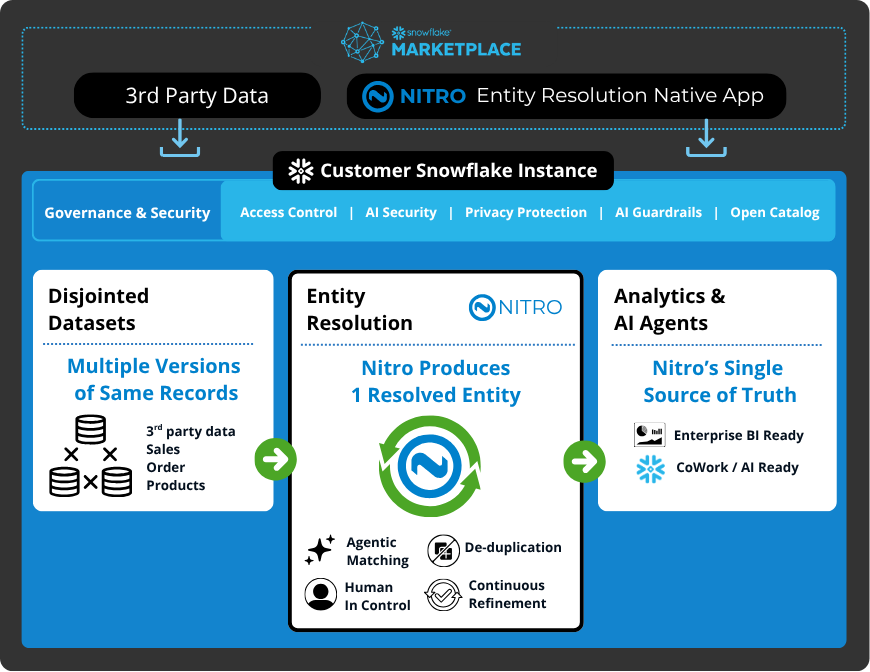
This is why we built Nitro as a fully integrated entity resolution platform using Snowflake Native applications. What we set out to create is a full, end to end solution which identifies and aligns the real world objects in your data, and allows for easy stewardship from the business, all inside your Snowflake warehouse. Here are three reasons why being “Snowflake Native” is the ideal solution for entity resolution.
Organizations rarely question why their data needs to move in the first place, it's just the status quo. Pick a vendor, ship your records out, and negotiate the contracts that come with it. Some teams sidestep that by building an entity resolution solution in-house, which trades one problem for a longer list: maintenance, scalability, governance, and technical debt.
The real game changer when running Entity Resolution as a Snowflake Native App is this: the application comes to your data instead of your data being sent to a provider. Simply put, your data never leaves your Snowflake environment, and processing occurs natively where the data already resides, making it the safest and most governed path to AI readiness.
The data staying inside Snowflake’s security boundary clears a whole list of security and compliance hurdles at once. Because nothing is ever copied to an outside environment, staying aligned with regulations like GDPR and SOC 2 gets easier, honoring your data-retention policies gets simpler, and your audit trail stays clean and entirely inside Snowflake.
Confidential data stays confidential. No third party ever needs to see your records. In an era where every vendor is hungry to train on your data, you can be certain yours is never used to train someone else's models.
Analytical workloads require up to date data, when it takes a week to process your data due to a refresh, you already missed the signals. With information coming from multiple sources, there are always new items, renamed fields, and hierarchy changes to account for. With your data always changing, resolving entities is not just a one time process, it is a continuous journey, needed for every update.
Third-party data makes this even harder. For example, Dun & Bradstreet updates hundreds of millions of data elements in its commercial database every day and estimates that 20–30% of company records go obsolete within a year.
By making entity resolution native to Snowflake, every new match, hierarchy change, corrected record becomes instantly available to downstream dashboards, analytics, AI models and Snowflake CoWork. There's no ETL lag, no synchronization delays, and no waiting for the next refresh cycle.
Your business doesn't have time to wait, you need an entity resolution solution that removes the barriers to your data getting refreshed in real time.
Being built on top of Snowflake’s industry leading AI Data Cloud means a Native Application inherits the scalability, security, and governance of the platform. For an Entity Resolution solution, that means it can handle any number of data sources and records. It doesn't matter how big your data gets, the platform scales with your compute, so resolving tens of thousands of records and resolving hundreds of millions have the same consistent performance with no bottlenecks. You're simply drawing on the capacity Snowflake already gives you.
This is more important now than it has ever been. Enterprise data volumes were already climbing steadily, and the GenAI era has turned that climb into a data tsunami.
With Snowflake, you've already picked a platform designed to absorb exactly this kind of growth. The question now is whether the tools you run on top of it honor that decision. That's why keeping entity resolution native should be non-negotiable. The moment resolution happens outside the platform, you reintroduce everything you moved to Snowflake to escape: data leaving governed boundaries, pipelines to maintain, separate infrastructure to size, and a performance cliff waiting somewhere ahead. Whether you're matching products, customers, or suppliers, keeping entity resolution native means the solution keeps pace as your data grows.
You've already chosen Snowflake as your AI data platform. Your data, and AI models all live in the same place, so why wouldn't your entity resolution solution run there too? Bringing the application to your data and AI, where they already sit, is how you maximize the return on your platform investment.
The Native App Framework is what makes that possible, and the economics follow: a materially lower total cost of ownership than stitching together a multi-tool stack, no separate infrastructure to stand up, and no new security perimeter to defend. Procurement is simple too. You pay through your existing Snowflake spend (MCD) rather than signing a new contract and managing a new bill.
Uncover the hidden insights in your data today.